Review of Colin Powells It Worked for Me
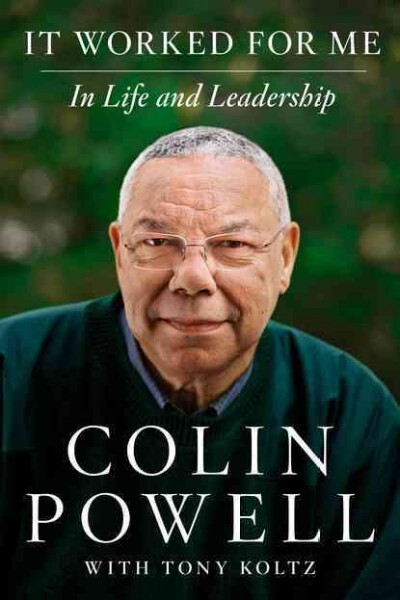
It Worked for Me
In Life and Leadership
If you're looking for advice on leadership, it's good to start with a four-star general. Colin Powell's new memoir, Information technology Worked for Me: In Life and Leadership, is a collection of lessons learned and anecdotes drawn from his childhood in the Bronx, his military grooming and career, and his piece of work under four presidential administrations. The memoir also includes Powell's aboveboard reflections on the most controversial fourth dimension in his career: the lead-up to the state of war in Iraq in 2003.
If there's a theme that runs throughout the book, it's Powell's beloved for the U.S. Army — from his days in ROTC, right through to becoming chairman of the Joint Chiefs of Staff. Powell says that dorsum when he was a lost 17-year-old at City College of New York, ROTC "saved" him and kept him in school.
"I found my identify. I constitute bailiwick, I found structure, I found people that were similar me and I liked, and I fell in love with the Army those first few months in ROTC, and information technology lasted for the next 40-odd years," Powell tells NPR'south Robert Siegel. "People accept asked me, 'What would you have done if yous hadn't gone into the Army?' I'd say I'd probably exist a bus driver, I don't know."
'I'll Never Leave It Behind'
But he didn't become a passenger vehicle driver — Powell went on to become U.S. secretarial assistant of state nether President George Due west. Bush. In 2003, he gave a at present-famous presentation to the U.North. Security Council on evidence of Saddam Hussein's weapons of mass destruction — which turned out not to be. Powell addresses that presentation in his book — in what he says will be his first and terminal account of the affair.
"I'll never leave it backside," Powell says. "It was the about vivid presentation of the intelligence information that we had, and it was designed to be the most bright presentation — that'south why we did information technology at the U.Northward., and I spent a great deal of time getting that data ready."
The case for war had been fabricated over the course of several months, and Powell says it had been accepted past the president, other world leaders, and most of the U.Southward. Congress. But he will ever be remembered as "the one" who presented the information to the U.N. "When I presented it to the U.Due north., I had every assurance from the intelligence community that the data I had was right," Powell says. "Turned out not to be."

U.S. Secretary of State Colin Powell addresses the U.Due north. Security Council in New York on February. 5, 2003. He presented prove of Republic of iraq's weapons of mass destruction — that turned out not to exist. Mario Tama/Getty Images hide caption
toggle caption
Mario Tama/Getty Images
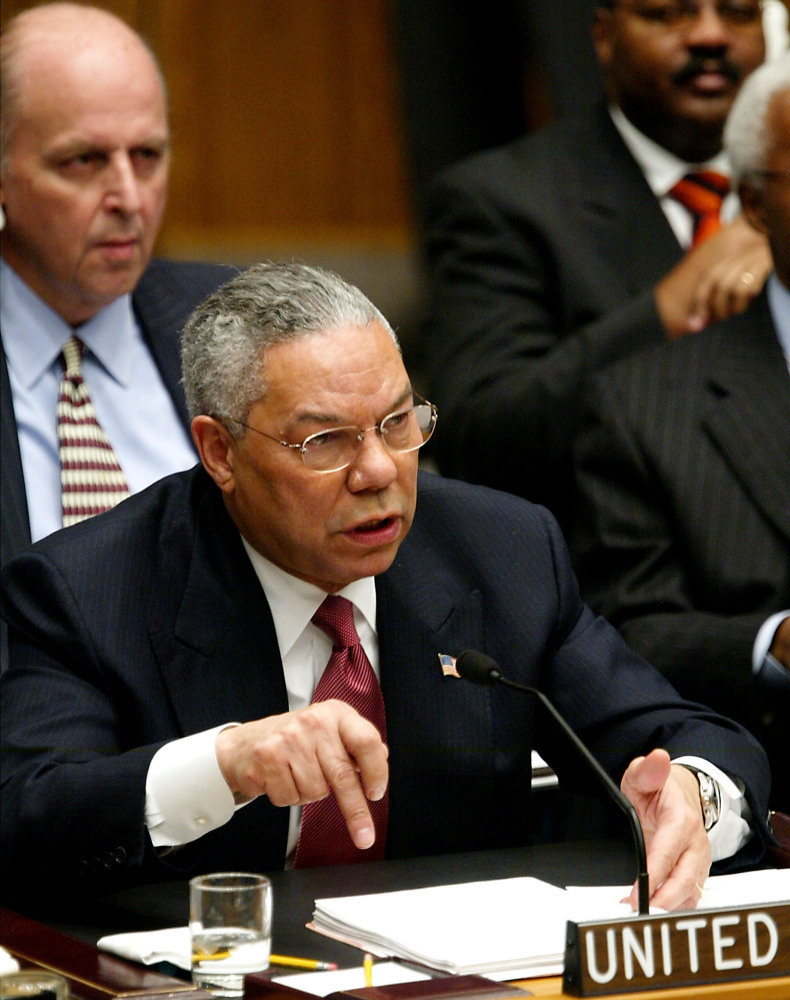
U.Southward. Secretary of State Colin Powell addresses the U.N. Security Council in New York on February. five, 2003. He presented evidence of Republic of iraq'due south weapons of mass devastation — that turned out not to exist.
Mario Tama/Getty Images
Powell writes that he at present knows that the draft that he and then-CIA Director George Tenet were presented with hadn't actually come up through the National Security Quango at the White House, but rather from Vice President Dick Cheney's part.
"But I didn't know that at the time," Powell says. "I knew when the president asked me to brand the presentation — I knew that the NSC was supposed to have been working on it, and therefore I would get something that was a near-finished document."
He wasn't aware, he says, that Scooter Libby, counsel to the vice president, was working on the document and that "it was not connected to the intelligence material, and so I couldn't use it as it was given to me."
CIA officials later wrote memoirs remarking on how bad the evidence was, and Powell says that he wonders: Where were they when the national intelligence approximate was being assembled?
"Some of them say that they tried to get it upward to the top levels of the CIA, that those sources should not be used," Powell says.
But he found it disturbing that later on some of the intelligence information fell autonomously, CIA officials said: Well, nosotros know they never should have been used past Powell.
"Well, then information technology shouldn't accept been used by the president, and shouldn't have been used by the Congress, shouldn't have been available to everyone," Powell says.
'Lessons Learned' In Iraq
Afterwards nearly 8 years of war, the U.Due south. withdrew its last troops from Iraq in December. "The Regular army will accept its lessons learned," Powell says. "They're excellent at looking into themselves and reflecting on what did we practice right, what did we do wrong."
On the whole, Powell says the Army "did quite well," but that there were command problems that should have been handled differently. "A inferior full general should not have been suddenly given command of all of Republic of iraq at that time," Powell says. "Some of the more than senior commanders were sent home, and the fundamental commander Gen. [Tommy] Franks essentially left and went into retirement."
There were also expectations nearly the course of the state of war that didn't plow out to be true.
"There was an assumption ... that this was all going to snap back in place, it would be easy once Baghdad vicious," Powell says. "But it became obvious early that was not going to be the example."
Gen. Franks and Secretary of Defense Donald Rumsfeld thought they had a sufficient number of troops — only greatly underestimated the force they would ultimately need. But Powell doesn't believe that the legacy of the Iraq war will be that the U.S. will ever demand more and more troops. And he doesn't think that'south the right answer, either.
In ane chapter, he refers to "The Powell Doctrine," which states: "Once y'all've decided what the political objective is and that you take to become to war, put in plenty troops to exist decisive," Powell says. "In this instance, the decisive point that they focused on was the fall of Baghdad, just ... that wasn't the end of the conflict; it was the beginning of a new phase of the conflict. Military planners should always be thinking about what happens subsequently y'all accomplish that outset thing, what else you're going to take to practice."
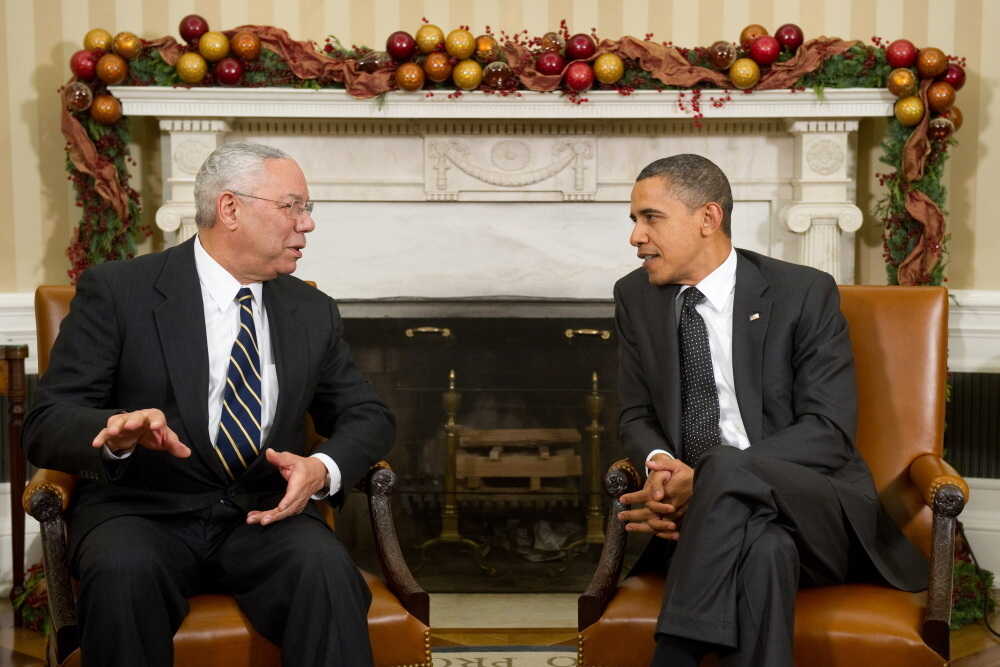
Powell endorsed Barack Obama for president in 2008. "I'k proud of the vote I bandage for him in 2008, I think he was absolutely the right option," Powell says. When information technology comes to the 2012 election, Powell says he's "not prepared" to say who he'll be voting for. Saul Loeb/AFP/Getty Images hide explanation
toggle explanation
Saul Loeb/AFP/Getty Images
Powell endorsed Barack Obama for president in 2008. "I'm proud of the vote I bandage for him in 2008, I think he was absolutely the right option," Powell says. When it comes to the 2012 ballot, Powell says he'southward "not prepared" to say who he'll be voting for.
Saul Loeb/AFP/Getty Images
Some other Vote For Obama?
Powell was a star in Republican administrations, but in 2008, he announced that he would be voting for Barack Obama for president. Now, 4 years later, he's not prepared to say whether he'll be voting for Obama once again.
"I'one thousand proud of the vote I bandage for him in 2008, I think he was admittedly the right pick," Powell says. "I think he'southward done some very, very positive things to stabilize our financial organisation, save the auto industry, to bring some regulation into the mix, and we've ended ane war — the one in Republic of iraq — we're working on phasing out Afghanistan, and we haven't gotten into any new ones."
But he has enough of critiques of the Obama administration as well. "Nosotros didn't close Guantanamo as I would take hoped, and nosotros nonetheless have an unemployment rate that'due south too high, and the economy has not quite recovered." Powell says. "Whether that'southward all the mistake of the president or not will be upwardly to the people to decide."
Powell has known Romney for many years and says he's a "very distinguished gentleman." Powell is looking frontwards to hearing what Romney has to say in the coming months.
"You're not just voting for an individual," Powell says. "In my judgment, you're voting for an calendar, you lot're voting for a platform, you lot're voting for a political philosophy. And I desire to really hear what Mr. Romney has to say near that now that he's gotten through the primaries where he had to deed in a somewhat unlike fashion."
thomasloyarround1951.blogspot.com
Source: https://www.npr.org/2012/05/22/153296714/it-worked-for-me-life-lessons-from-colin-powell
0 Response to "Review of Colin Powells It Worked for Me"
Post a Comment